

The Performance of Compassion
Perez Hilton's public collapse exposes disposable concerns over mental health

Trigger warning for a detailed discussion of self-harm, suicidal ideation and cyberbullying.
Last week, professional internet troll Perez Hilton had a very public mental health crisis that was livestreamed on his social media. Hilton streamed for 30 minutes, visibly disorientated, harming himself with a knife, having barricaded himself in his own home. He watched the arrival of law enforcement stating that he hoped they killed him and that he was doing all this for his children.
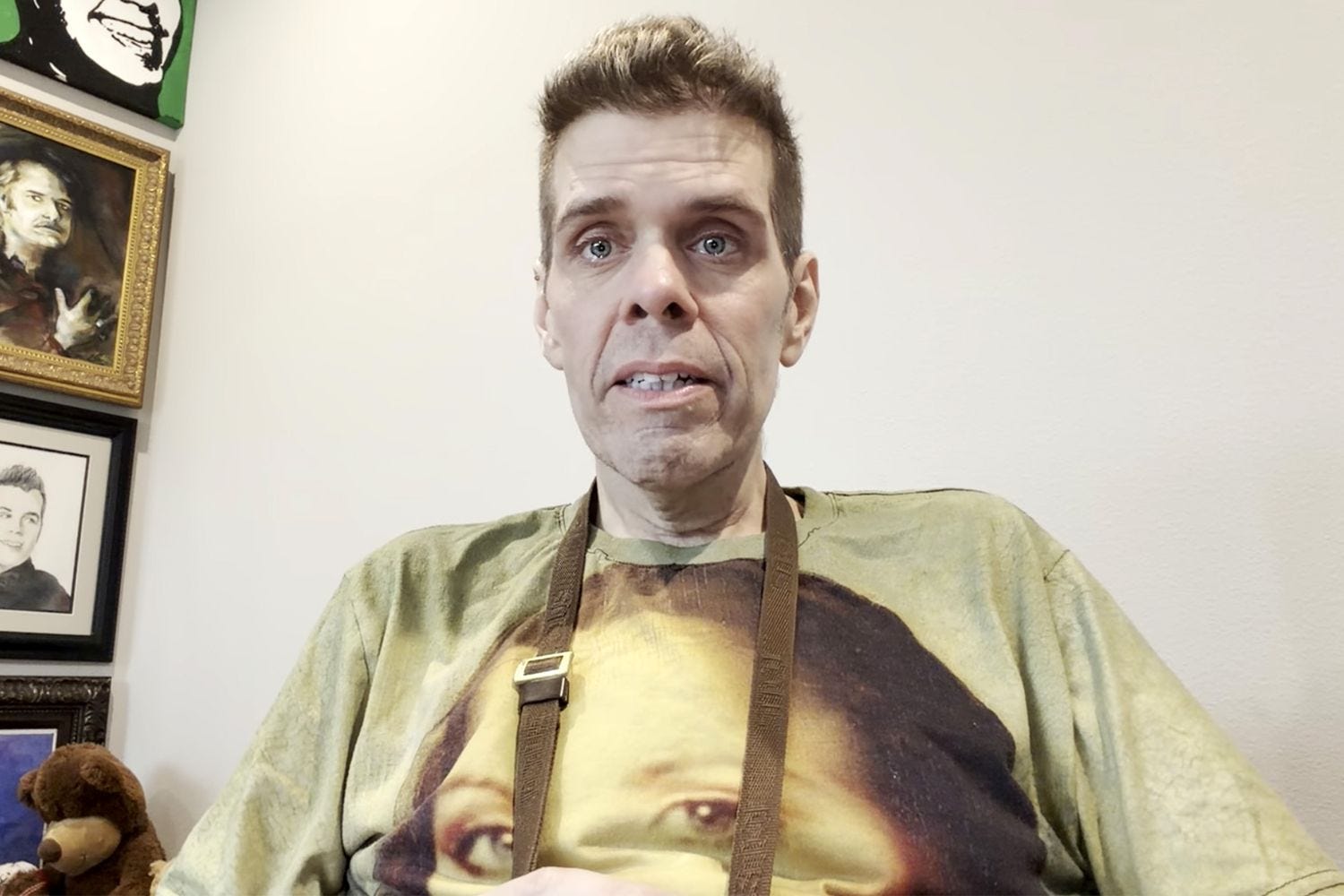
Hospitalized under Florida’s Baker Act and held for psychiatric evaluation and treatment for his injuries, the incident has sparked for many a nuanced (and often a not-so-nuanced) discussion about the immense harm Hilton built his platform and career enacting, with sympathy for those in crisis and the struggle to identify genuine remorse.
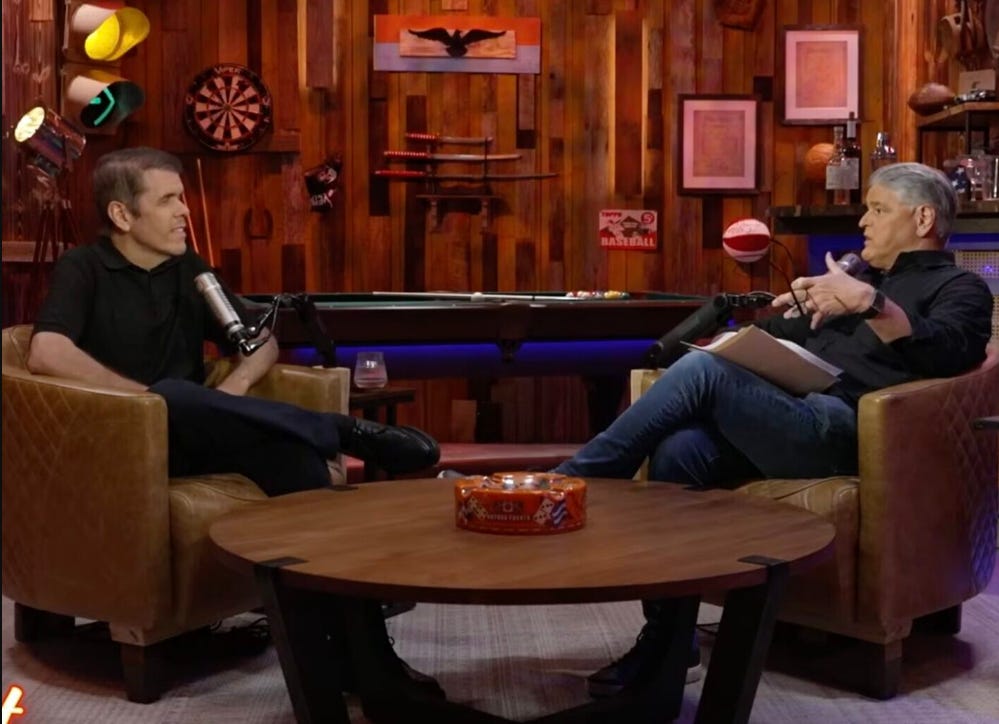
Just before his incident Hilton gave an interview to Sean Hannity expressing regret for a career that can only be described as professional bullying, to put it charitably. He shared that he “realized what I was doing was wrong... I didn’t have to be so cheap and I don’t have to be so cruel” calling it his “scarlet letter” and lamenting that he struggled to find romantic relationships as most gay men “hate me” due to his public behavior.
The catalyst for this change was Hilton developing severe sepsis in March and spending 21 days in hospital. The near-death experience seemed to have a profound impact. He came out the other side with an emotional video about having a religious vision of God, apologizing for his “selfish behavior,” and promising that he would be “doing things differently than before”.
Just weeks later, Blake Lively posted an Instagram story responding to Justin Bieber’s Coachella performance saying that so many people we love are hurt and never come back to themselves:
… the collective looks back when it’s too late with empathy that was missing at the time.
Shocked everyone treated someone’s most painful days as entertainment.
But that isn’t behind us.
It happens daily. makes money. It gets clicks. Followers. Virality.
The collective often unintentionally ravaging the health of an entertainer because everyone feels a right to them for being in the public eye.
One might think these words would resonate with Hilton’s new perspective on his own behavior of exploiting pain for entertainment. At the very least we might expect him to recognize the way his own pain is treated as entertainment given that the “people out there who wanna see me suffer and wanna see me pay for the mistakes and the bad decisions and the hurt that I caused in the past”.
Instead he did neither, responding to the post by calling Lively a litany of nicknames: Judicial Judas, Malice in Wonderland and Self-defamation Serena. Attacking her for playing the victim and inviting his comment section to add to the pile on. Hilton was preaching the words of a changed man, his content, however, went right back to the outrageous and salacious exploitation it has always been.
This also is not the first time Hilton has vowed to be an improved and changed man. As part of his “Damascus moment”, as Hannity calls it, Hilton expressed that he had reached out and made amends with various celebrities including retelling a story of him meeting Jennifer Aniston. If the story sounds familiar, it is because it originally dates back to 2011 when Aniston recalled confronting Hilton about his mean comments on Ellen. Hilton, who had nicknamed Aniston “MANiston”, said he regretted the nickname and had not seen her as a real person. This humanizing moment appeared to have been quickly forgotten as Hilton had no issue inventing a whole new list of insulting nicknames for his targets over the following 15 years.
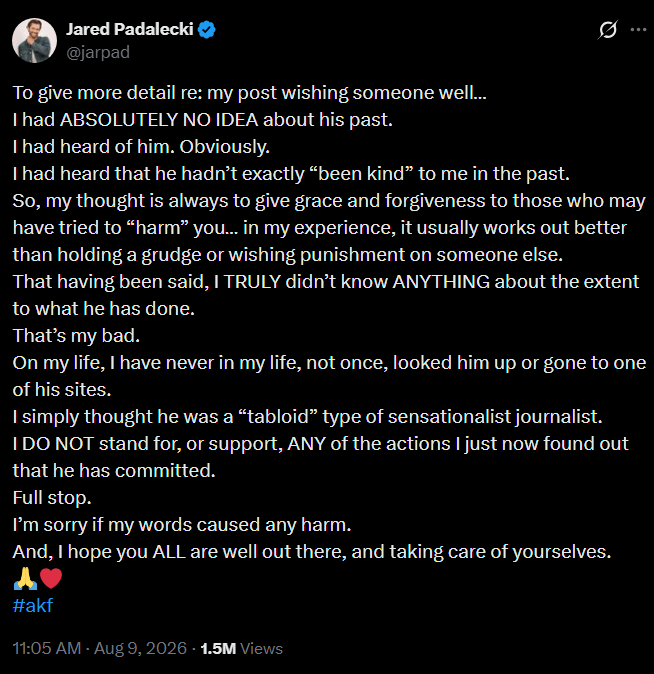
The conversation about Hilton has inspired many conflicting feelings as people wrestle with expressing sympathy for him and his family, while also acknowledging the very real harm he has caused. Jared Padalecki initially offered a tweet of support, but later deleted it and apologized upon learning “the extent to what he has done”.
That list of “what he has done” includes Hilton actively exploiting and, importantly, monetizing his harassment of Britney Spears, Amy Winehouse and Lindsay Lohan during their own mental health issues. After Heath Ledger’s tragic passing in 2008, Hilton sold custom t-shirts featured Ledger’s image alongside the text “Why couldn’t it be Britney?”. Taylor Momsen shared how Hilton published a photo taken up her dress, showing her tampon string as a child performer. Hilton also tweeted to the 16-year-old Momsen, after posting an article about how she couldn’t live without her dildo, that she needed to replace it with a fisting toy. A year after Lily Allen’s tragic miscarriage, Hilton posted that Allen as a mother would be a “disaster” and she should “stick to intoxication instead of moving on to procreation. It’s what you know best”.
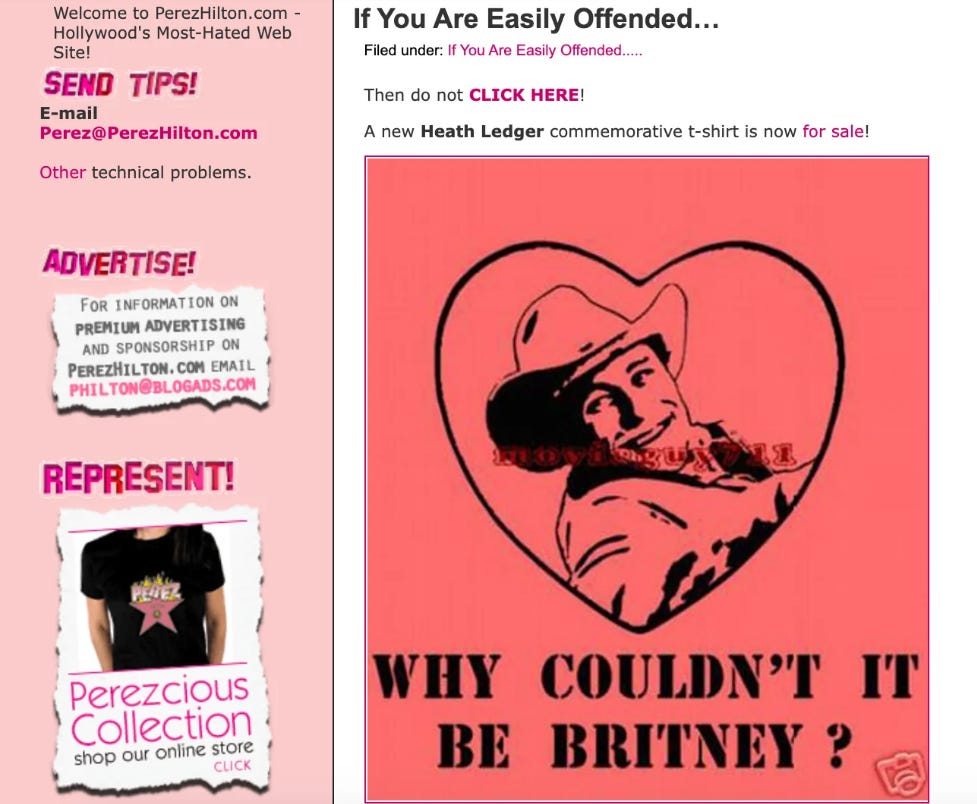
Whatever the crisis, Hilton never once encountered a personal low, in others or his own, he couldn’t turn into a craven opportunity to profit. It would almost be an impressive craft if it weren’t built largely from other people’s suffering.
It is no surprise then that one of the first to cover, and thus himself monetize, Hilton’s breakdown was Zack Peter, a discount impersonator who’s copied Hilton’s entire act, right down to the inability to form lasting romantic relationships. Peter capitalized by making multiple videos the night of the incident even regurgitating an early, incorrect, tweet that this was a “hostage situation”. There’s an irony that the man exploited Britney Spears’ breakdown, was now having his own breakdown exploited for a paycheck by the various value brand knockoffs he has inspired.
What is hard to understand is why anyone would want to emulate Hilton’s brand of cruelty. Ireland Baldwin named Hilton’s impact on her life, saying he had made “unforgiveable comments”, humiliating her family for years, had sexualized her “from an early age” and “has always been a despicable human being”. While also saying that “his children deserve better and a healthy father”, that she was so sad and hoped Hilton gets the help he needs.
When I said something similar online last week, that I felt for Hilton and his family, despite previously being very critical of him, I got called out for false empathy. I understand why this would be the assumption. Our culture celebrates retribution, outright endorsing and encouraging violence, just so long as it is directed at the right target. Hilton, we’re told, should be made to suffer the way he made others suffer. For many, this incident is easily written off as long overdue karma. We tell ourselves it’s ok because, using the most dangerous words ever uttered in the English language: They deserve it.
Behind the dangerous idea that some people deserve it, however, is the entire reason why Hilton and his copycats are so popular. The crowd loves to see all grades of celebrities humiliated, insulted, degraded and read to filth for the sin of various transgressions of being too dumb, too smart, too pretty, too ugly and the crime uniquely directed at female presenting public figures: too successful.
Yet if we truly wish to escape this never ending cycle of deserved violence, we must aim for the harm to stop and the people involved to actually heal and make amends. To paraphrase the words of George Bernard Shaw, if you intend to punish a person retributively then you must harm or injure that person. If you instead intend to reform them, you aim to improve them but people are not generally improved by harming them. We must decide, is our goal to injure or improve? As difficult and discomforting as it is, wanting less exploitation and suffering in the world shouldn’t be put on pause because the person on the receiving end of our empathy benefited from inflicting that abuse.
What informs my own perspective here is that I’ve been where Hilton’s family are, many times in my life. I’ve sat in hospital waiting rooms anxiously waiting to hear a loved one has been stabilized, fearing the worst. Rifling through closets to pack clothing for the duration of unexpected psychiatric holds. Or watched a young child’s heart break into a thousand pieces trying to process it all. Terrified and scared seeing a parent in pain and hurt, while also feeling abandoned by the one person who was supposed to stay. Struggling to reconcile why they aren’t an important enough reason to keep them here and the guilt of feeling like they are to blame for that.
It has also bled into my professional life, having to manage workloads and team priorities to allow a team member the space and time to heal and recover. Without fear of losing the job, and with it the health insurance, funding their treatment plan.
So while it may confuse others, it is against this backdrop I watch Hilton and can’t find comfort in his downfall, much as the internet urges us to. I only find more pain, suffering and a deep sense of sympathy. Because what I remember most from these incidents, isn’t the event itself. In one instance I suppressed the memory of it for years. Instead it is the hypervigilance those events created. The sense of anxiety and concern anytime you’re forced to leave them by themselves. The fear and dread when you return to what you might discover.
The data backs up why: the biggest risk factor for completed suicide is a previous attempt and the overwhelming majority of those will do so within the first year. For the loved ones of those who survive, it creates an exhausting need to read every mood, every closed door and unanswered text as a warning sign and potential red flag. Establishing a constantly disrupted and dysregulated nervous system that is never allowed to relax for years, often for an entire lifetime. For a child, living with that trauma creates a significant burden on their own mental health.
For men the picture is particularly grim. In roughly 60% of completed suicides in men, there were no known mental health conditions. To be clear, that doesn’t mean those men had no mental health concerns. Those without known mental health conditions had higher rates of relationship or intimate partner problems, arguments, physical health issues and alcohol use. It means none of it was documented by a professional. No therapist, no diagnosis, no file anywhere flagging the risk. Which is important as it means there’s no mechanism for intervention. The systems we’ve built to catch people in crisis work by training professionals on what to look for, but if the individual in crisis never consults a professional, there’s no ability to raise the alarm.
Hilton doesn’t fit that pattern. His decline was public and visible for months and only serves to prove how badly we’re failing at this even when the warning signs are front and center. The sad and unfortunate consequence of a culture that has been built to treat mental health as a hash tag, a concern to pay lip service but otherwise largely ignore.
Case in point, I also said the sudden and overwhelming concern about mental health wouldn’t outlast the news cycle. That the awful people running an economy built entirely on humiliating people for clicks were not about to be suddenly burdened with self-awareness just because one of their own ended up hospitalized and would return to business as usual within 48 hours.
I was outrageously naive and optimistic. Not only did the newfound concern over mental health not last a single hour, it didn’t even last until the next segment. Kjersti Flaa, in her video covering the news about Hilton which she called “sad and disturbing”, jumped immediately to attacking those in Hollywood, the entire topic of her content, as “psychopaths” and “narcissists”. Zack Peter closed his segment on Perez urging viewers to “check on your friends. mental health is real” and then dove right into mocking Tom Sandoval for having a “tiny penis”, referring to him as “Tiny Tom Micropene”.
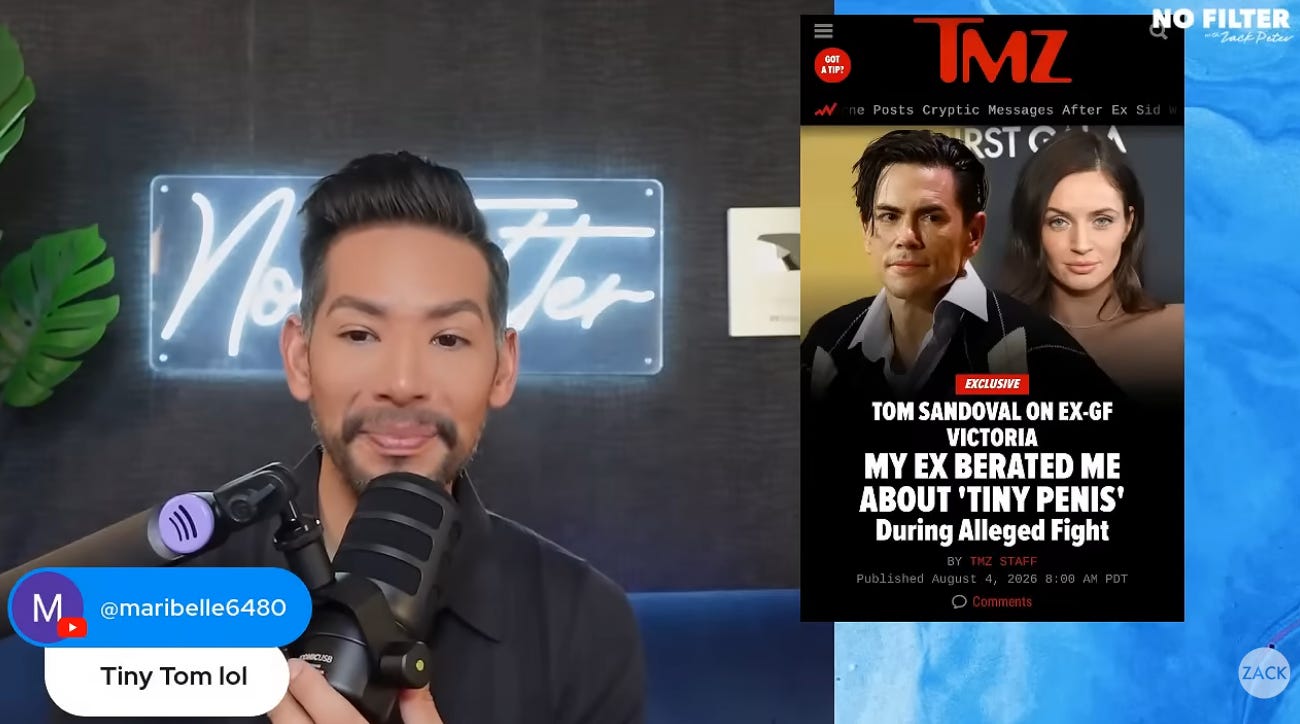
It isn’t just the creators. Scroll into the comments under any celebrity with an embarrassing paparazzi shot, or awkward interview clip, and you’ll find the same crowd showing up to insult and degrade people they’ve never met, using language they’d never dare say to someone’s face. Then, when their victim finally turns their comments off because the harassment is too much, the same crowd shows up to brag about bullying them into submission, calling out their thin-skin and cowardice for refusing to subject themselves to further insults and torment.
We have built an entertainment economy where being cruel to strangers is normal.
Hilton has spent two decades training an entirely new generation of imitators how to mock and exploit someone else’s pain as a profitable career path. Those imitators have proved how well they learned that lesson, pausing for barely a moment before getting straight back to work on sending their next target to a breakdown. If there’s a lesson worth taking from any of this, it’s that an industry built on dehumanizing people for entertainment isn’t going to stop itself, happy to feast on the pain of its own for profit.
What this incident should really be forcing us to look at is not whether Perez Hilton is worthy of forgiveness or compassion, which is largely between him and the many people he harmed. The actual conversation is about why we suddenly only find the compassion to acknowledge a person’s mental health struggles only once they are hospitalized, not before. Why we are unable to find the same compassion, the same disdain of suffering being used for content, for the people currently torn apart in comment sections right now. Acknowledging the very real harm this bullying has on the mental health of all involved. Today. Not the next time someone we’ve been laughing at ends up in a hospital.
If you or someone you know is struggling, the 988 Suicide & Crisis Lifeline is available 24/7 by call or text. You can also find additional warmline resources here, via Inclusive Therapists.