

When men choose the Bear
Horror movie Obsession is a litmus test on consent, and men are failing it

Trigger warning for graphic descriptions of trauma and abuse, violence and sexual assault. The following piece will also discuss major plot points of the films Obsession and Get Out. If you do not wish to have these movies spoiled, please skip reading
Two years ago, a question was posed that went viral: Alone in a forest, would you rather encounter a bear or a man? Women, near universally answered a bear. Their reasoning is understandable. The UN estimates roughly one in three women worldwide will experience intimate partner or sexual violence in their lifetime and the majority of women are murdered by men. Of those, 9 out of 10 will be killed by a man they know.
Bears on the other hand are predictable, they just want your snacks, not your body. You also don’t face the daily anxiety of living with a bear and wondering if today is the day he’s going to explode into violence.
Men, by and large, were upset at this hypothetical. Comment sections filled with accusations of being “misandrist”, explaining at length how bears actually maul people constantly (they do not, statistically, with less than one fatal attack per year), and making memes of women being brutally mauled by bears. In doing so proving exactly why women are likely better off with a bear.
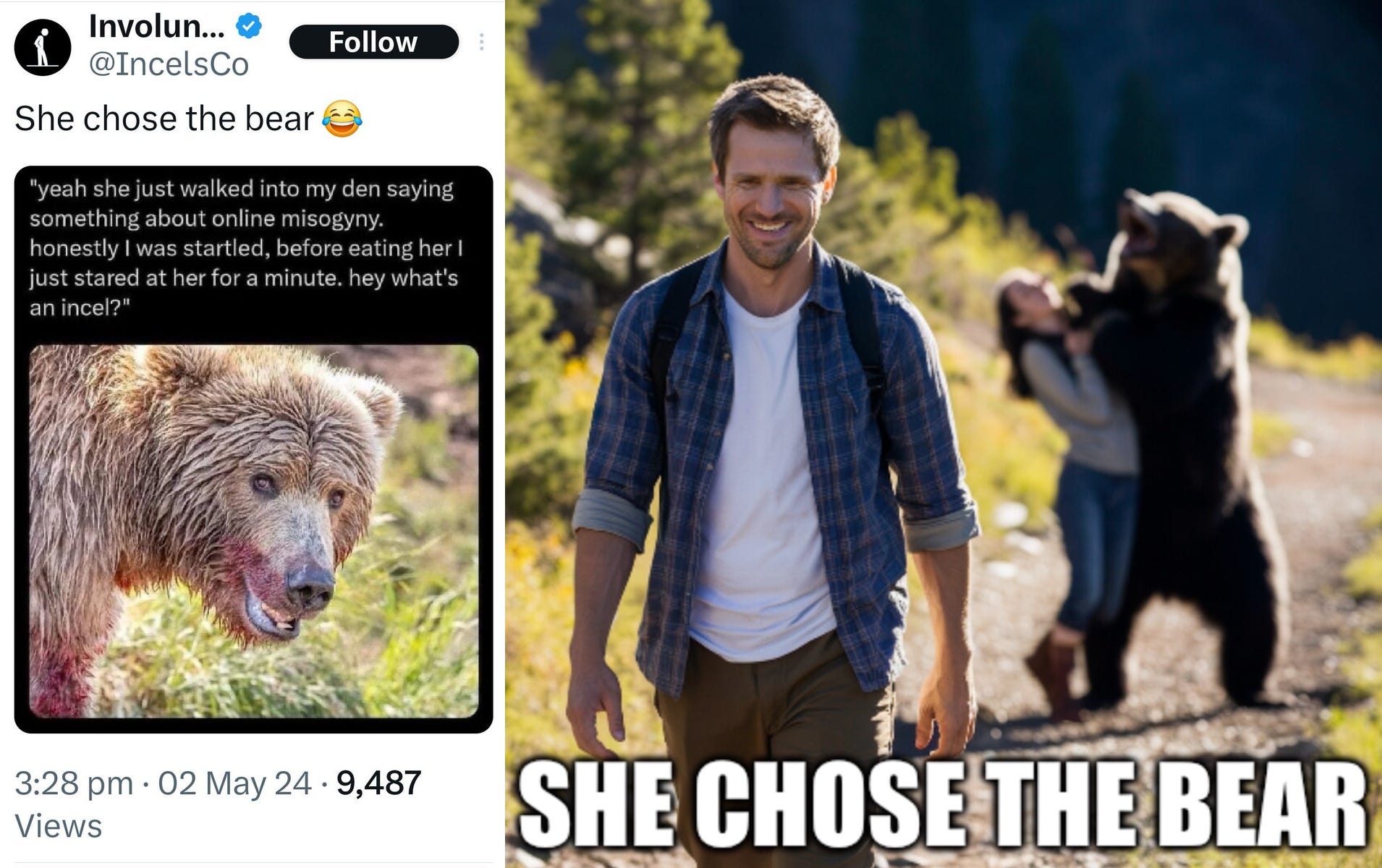
It would seem to be an obvious and easy litmus test to pass: Don’t minimize and endorse violence against women. Yet a new horror movie has men once again stumbling and struggling to clear this low bar. Only this time, they’re choosing the Bear.
Obsession (2025) is the story of Baron, nicknamed Bear, and his friends Nikki, Sarah and Ian who all work at a music store owned by Sarah’s father. Bear has long held romantic feelings for Nikki and has been struggling to build up the courage to tell her, while Ian has been gently discouraging him from disclosing them. As the friends head out for a night of trivia, Bear buys Nikki a gift and plans to confess his feelings. He buys what he believes is a harmless toy, a One Wish Willow, which when broken grants the owner a single wish. Defeated and unable to share his feelings, Bear uses it himself and wishes for Nikki to love him more than anyone else in the world.
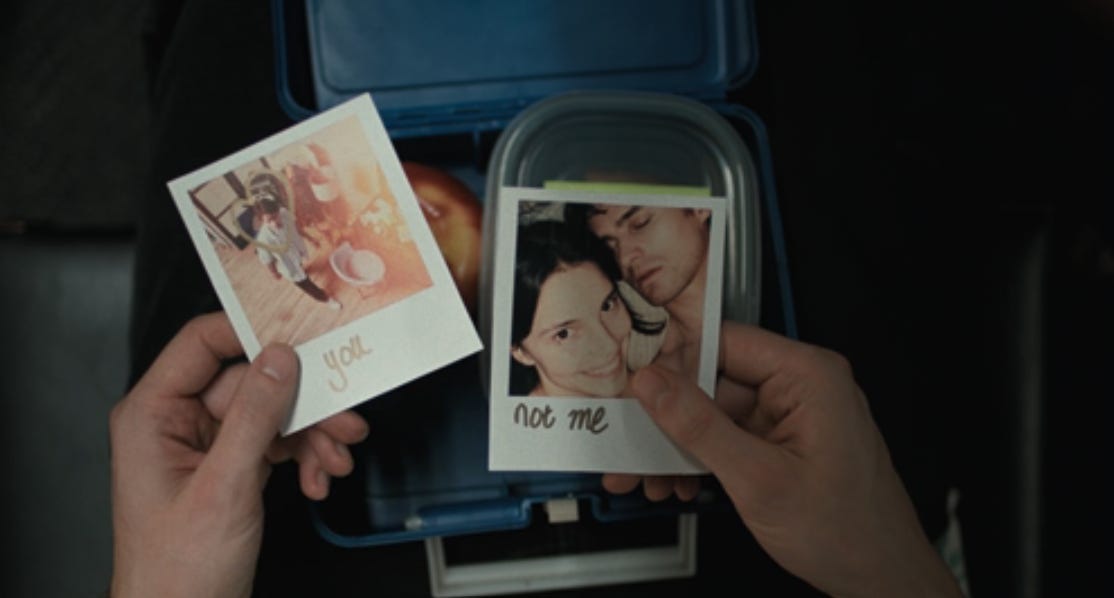
What follows isn’t romance, but body horror. Nikki’s transition from platonic friend to obsessive infatuation is immediate. She insists Bear take her to his home and climb into bed with her. Nikki kisses Bear, but screams and pushes him away, then apologises and excuses her behavior. He wakes in the middle of the night to find Nikki standing in the corner of the room crying. She asks why he doesn’t love her like she loves him. Nikki tapes the door shut to prevent him from leaving for work, then stands motionless waiting for his return, wetting herself. Bear finds Nikki has packed him a lunch including two Polaroids, one a photo of Bear circled and labelled “You”. The other a photo of Nikki next to Bear asleep labelled “Not me”. As well as a meat sandwich, made from his recently deceased cat.
The film is not subtle about its themes of control and consent. Ian initially suggests Nikki’s change in behavior is due to the influence of MDMA. As time goes on, unable to make sense of Nikki’s behavior Bear’s friend group withdraws believing the unhealthy relationship to be a result of Nikki exploiting Bear or vice-versa. There’s an uncomfortable sex scene where Nikki lies, head to one side, clearly detached and dissociating. Nikki escalates to violently harming herself, then during the middle of the night telling Bear that the other Nikki was asleep, sobbing and begging him to kill her. Bear’s response lacks any empathy or understanding and centers his own feelings “What’s so bad about being with me?” Nikki tells him, “I’ve never been with you”.
Bear is clearly the villain of this piece. The film’s writer and director, Curry Barker, revealed he was offered $2M, double the film’s budget, to rewrite Bear as the hero. Barker declined saying the story is more interesting having Bear “making bad decision after bad decision”.
It would seem, then, an easy bar to clear for men to walk out of the movie with the male fantasy of the subservient wife with no thoughts or desires of her own except the singular desire to always please her man thoroughly dissected, discarded and rejected.
And yet, for a certain segment of men, their response has been to find the many various ways to excuse Bear’s villainy and avoid labelling him a rapist. The first is to imply that Nikki had been possessed, despite Curry Barker expressly telling the cast this was not possession. If it was the Wish Nikki who initiated the kiss and the sex, then as one X user asks “how do you expect Bear to decline?”. This runs into the obvious problem that a third party does not own your body to be able to offer consent any more than a renter owns and can sell the property they are renting. But there’s also a more insidious framing going on here. It repackages men’s unwillingness to decline a woman’s advances as an inability. Bear didn’t choose to be a rapist, he was compelled, making him just as much a victim. DARVO it seems, is alive and well.
For others, they went much further in painting Nikki as perpetrator. Popular YouTuber Alex Meyers in his, now deleted, review of Obsession, went out of his way to repeatedly suggest Nikki as a Latina character with an interest in crystals and writing was always on the path to obsessive behavior. “Get out while you still can” he urges to Bear saying that “this movie would have gone the same way for Bear whether he made the wish or not”. Meyers’ review he says was in response to having “seen some internet comment threads where it’s like he only saw her as an object and wanted to remove her autonomy. That’s why he made that wish”. Missing the fact that this isn’t some hot take, but the literal verbatim plot of the movie.
While Meyers was rightly criticised for justifying and excusing Bear’s behavior, he does at least ultimately conclude Bear is a villain and recognize that objectifying and removing consent is wrong. Other responses disappointingly fail to even reach this conclusion.
During the movie it is revealed that Sarah secretly has feelings for Bear, which were missed because of Bear’s obsession over Nikki. Before the characters can act on this however, Nikki appears and violently kills Sarah by bashing her face repeatedly with a brick. Nikki says she’s sorry Bear had to see that, but it is his fault, after all “This is what you wanted”.
Posting various pictures of Megan Lawless, the actress who plays Sarah, in revealing outfits, internet users argue she is more attractive, already had feelings for Bear and so the correct conclusion to draw from this scene is that Bear wasted his wish on Nikki. Arguing in essence that the problem with Bear’s wish was simply that he picked the wrong woman to rape. One user goes so far as to say that Bear choosing Nikki over Sarah “might be one of the biggest romantic mistakes in modern horror”.
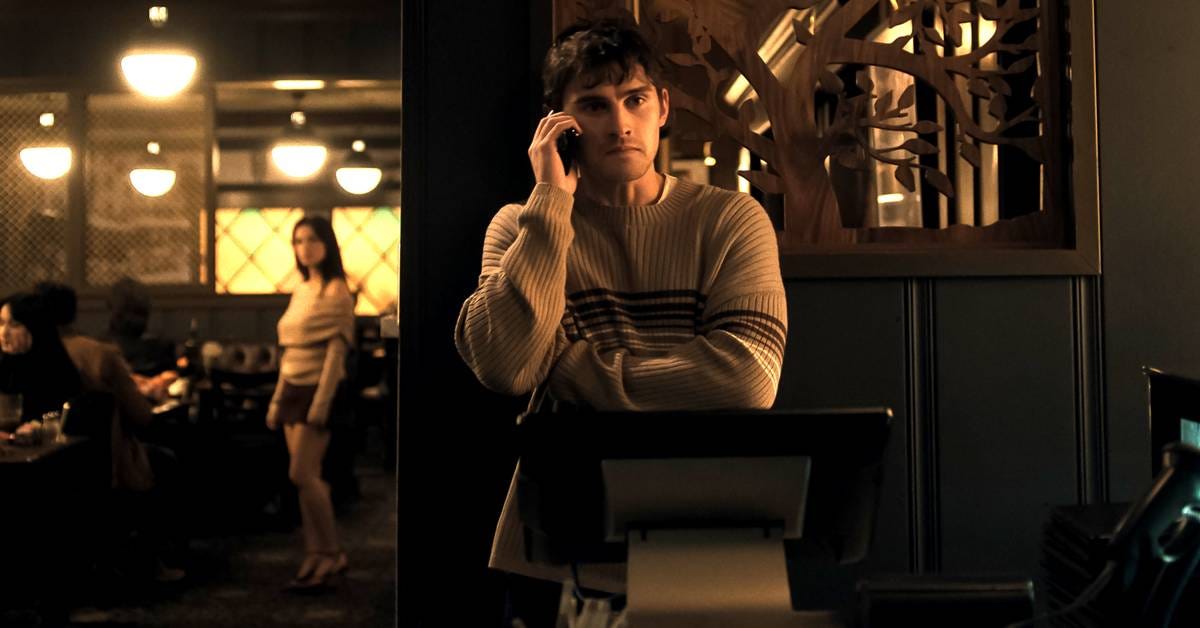
The mistake here is believing Sarah having feelings for Bear makes overriding her free will any less of a violation. It is still rape. It would just be easier to comfort his conscience with the lie it was romance. Scratch the surface and what’s actually being argued is that violating a woman is more forgivable, even more excusable, if she showed interest first. It’s the same logic used on real victims every day, picked apart for what they wore, how they smiled, how their behavior prompted the lustful thoughts that left their abuser, like Bear, “compelled” to act. How could he possibly decline?
Seen this way, what we’re encountering isn’t film criticism: subjective judgment of art, craft and technique. This is rape culture bleeding through how we interpret a film and a character’s actions, taking it from something that most men, in polite society, would view as a vague abstract concept they themselves would never endorse and seldom ever encounter, and demonstrating it is the predominant lens through which a large number of them are watching a movie that is unambiguously about rape.
Even Nikki isn’t immune from being viewed through this lens, with multiple commentors saying that Nikki was “leading Bear on” and flirting with him, that Bear “didn’t force anything on her” and the age old question asked of all victims of abuse, if she didn’t want it why didn’t she leave. They say this despite the film confirming within the opening five minutes that Bear has never even flirted with Nikki, let alone the reverse.
When Bear realizes he is unable to control Nikki’s erratic and disturbing behavior he calls the Customer Service line for his wish. He’s asked if he wants to talk directly to Nikki. Instead of her voice, we hear her unleash a raw scream that is the pure agony and desperation of someone begging to be released from their prison.
There is simply no reading of this as wanted.
I’m reminded of another body horror movie where the victims are rendered a helpless passenger in their own bodies, 2017’s Get Out. As the film progresses Chris spends the film walking past a number of red flags. He stays the weekend anyway, even as the audience and Chris get the growing feeling that something is not right.
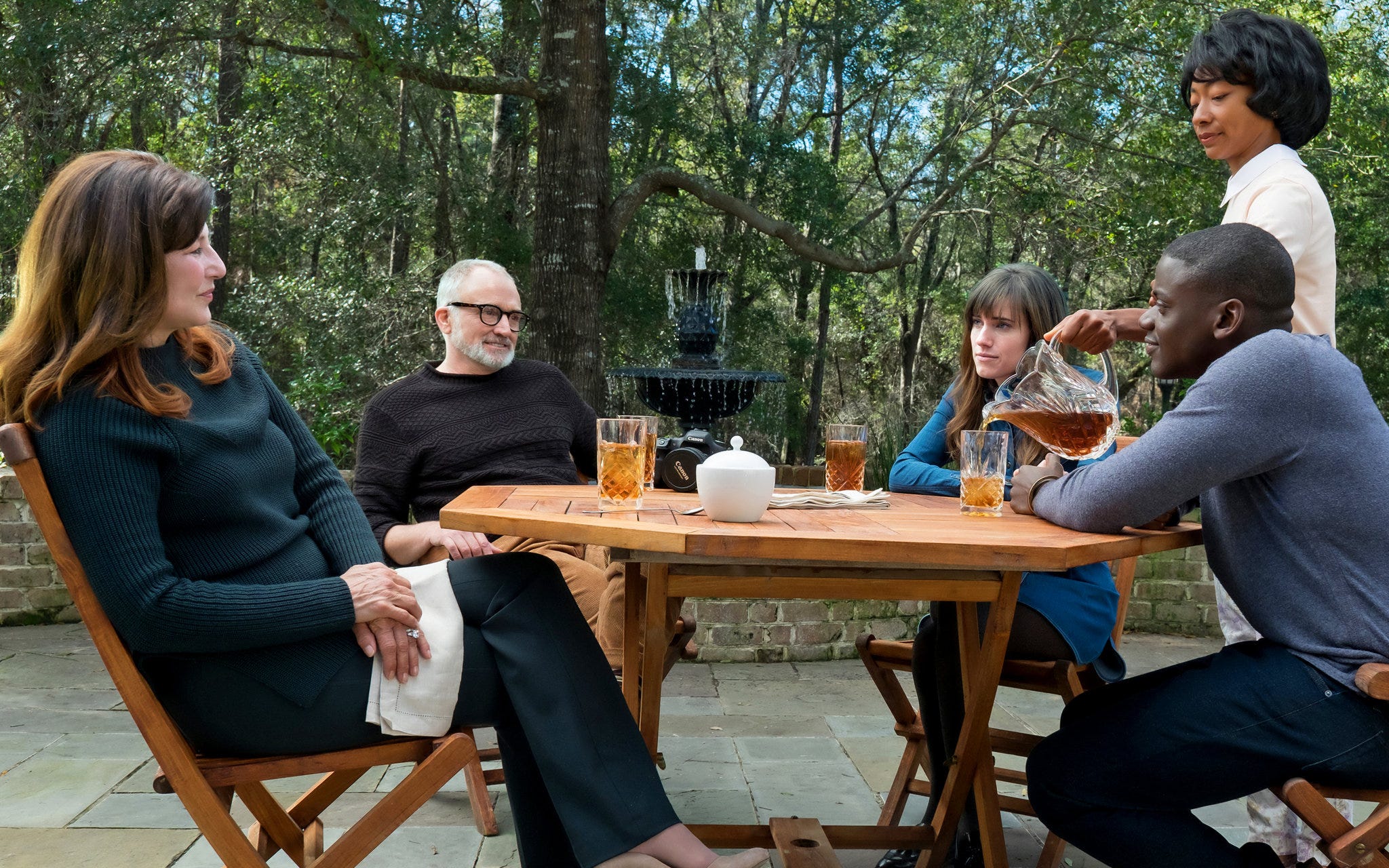
Yet viewers of Get Out would not argue Chris wanted his body colonized, or that his politeness toward Rose’s family somehow invited it. His willingness to give people the benefit of the doubt and remain pleasant through racist micro-aggressions and odd behaviors is rightly seen as the learned survival behavior of someone in a vulnerable position among those with more power and privilege looking to just keep the peace. The strategic de-escalation tactics of someone who knows they are in the presence of a bear.
Ultimately, in hindsight, downplaying the threat turns out to be a mistake for Chris but only because he doesn’t fully understand the gravity of the situation he is in, not because he did anything to encourage it. Nikki is not granted this same grace, instead her warmth becomes the evidence against her. Her only offense is extending the same kindness toward a friend she’s known her whole life, someone she has no reason to distrust. She is blindsided by a cursed toy she never knew existed. Despite that, knowing the arguments that what is happening definitely isn’t sexual assault are incredibly flimsy the fallback is conceding even if it is, the women it happens to all secretly enjoy it.
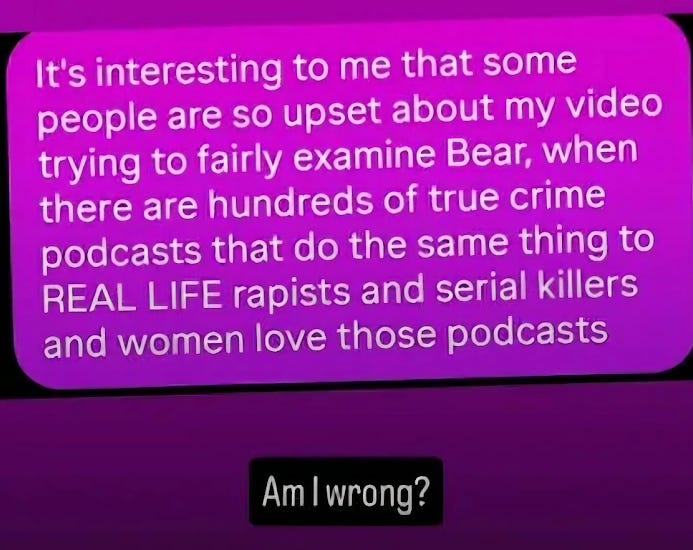
While fighting for his life facing the pushback for his review, Alex Meyers decided to double down and post to Instagram to say it is interesting he is criticised for attempting to “fairly examine” Bear, while women love true crime podcasts which do the same. The not so subtle subtext here plays into another tired trope, that women don’t just enjoy discussing rapists and serial killers they fantasize about them. With one commenter adding that Bear “just gave her the permission to stop pretending to be the good girl”. Women are incorrectly painted as a monolith, one a single ziptie away from breaking bad.
Nowhere, however, in this discussion about how we are socialized to these roles does the topic ever meander towards exploring male fantasies. Which predominately involve: teachers punishing students by forcibly having sex with them, landlords collecting rent from tenants by forcibly having sex with them, stop-loss agents punishing thieves by forcibly having sex with them and a whole variety of step-mothers, step-sisters and step-daughters who are discovered “trapped” in all manner of household appliances and furniture and are rescued by... you guessed it, forcibly having sex with them.
Around 3/4 of men consume adult content and a quick look at that content confirms that a majority of them are most aroused only when it involves degrading, humiliating and dominating women. The open secret of the adult entertainment industry is that much of it is not consented to.
Bear’s wish belongs to this same catalogue. Swap the position of power or faulty appliance for a One Wish Willow and the fantasy is unchanged: a woman stripped of any means to leave, refuse or object, existing only to be claimed by whichever man happens to be standing closest when the magic kicks in. The “nice guy” may just long to be seen, but it doesn’t change the fact that captivity is how he obtains it.
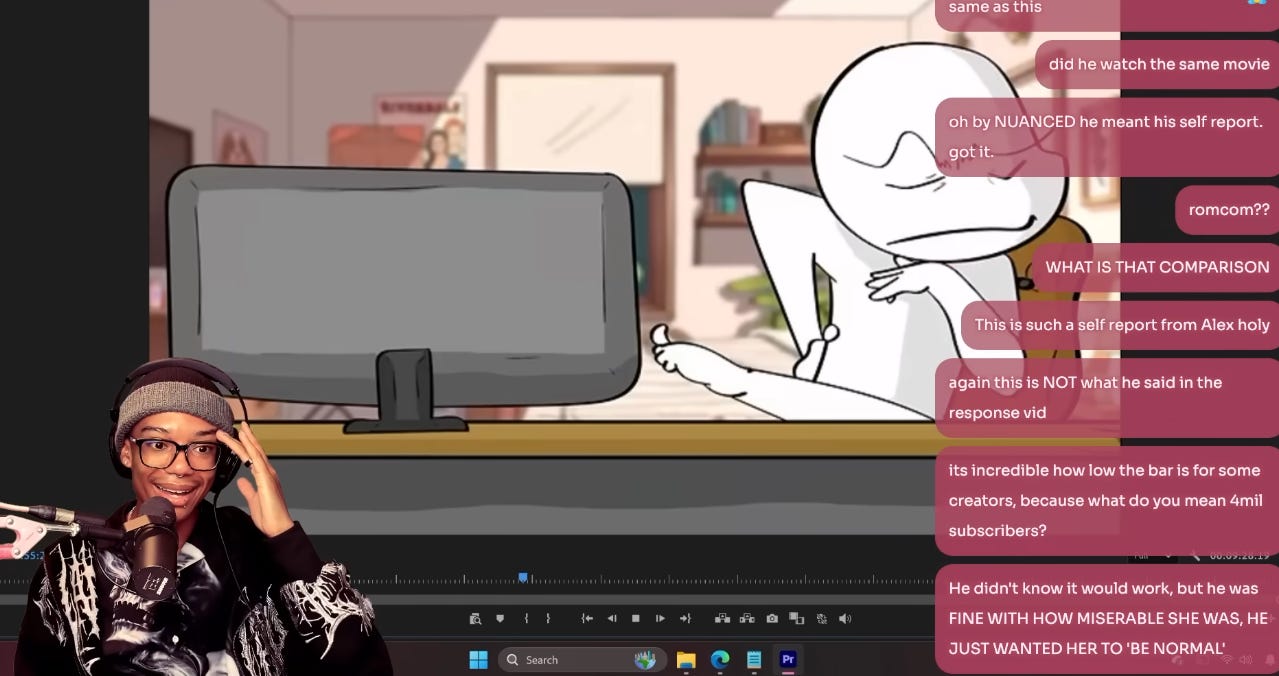
This normalization of male fantasies bleeds into the discussion around Obsession in more subtle ways. YouTuber D’Angelo provided a great commentary on Alex Meyers’ review that hits a lot of these points, but one place of agreement between them both is that Bear doesn’t start as a villain. Like a lot of commentary about the movie it splits Bear into two acts, he starts as a pitiable and shy Incel who wishes to be loved and only flips to villain at some undetermined point along the way, once it becomes undeniable the wish worked and that Nikki is trapped. Men near universally don’t see anything about Bear’s wish itself that is intrinsically wrong.
But we should and the film tells us we should. The other wish in the movie, Ian’s wish for a billion dollars, is granted without consequence. There’s no evil force or malevolent spirit at work corrupting the wishes. Ian’s money comes without any catch, other than an uncomfortable grilling from the IRS and law enforcement, entirely because it is a victimless wish. Bear’s wish, that Nikki love him more than anyone in the world, could never be realized without the exact control and consent issues the movie walks us through.
It isn’t just that Bear wanted to be loved, but that to him that love was exactly the kind of perfect doll subservience of a Stepford Wife. We meet Bear practicing confessing his feelings. Ian attempts to dissuade him knowing that Nikki does not reciprocate those feelings. Bear sees the hurdle facing him not in the content, but as a matter of delivery. Every step after this is an attempt by him to manipulate the situation to his advantage, Nikki’s feelings be damned.
When Bear hears Nikki has lost her crystal necklace he seeks to buy a replacement, but instead buys the One Wish Willow for her. He does so not out of concern for a friend, but hoping it’ll earn him brownie points he can cash in. He doesn’t offer the gift at the start of the evening, or offer the gift and delay sharing his feelings for another time. Instead he attempts to offer it only once Nikki is alone at the bar. Hoping to capitalize on the gift generating an outpouring of warmth from Nikki that would then make him sharing his feelings be better received.
It is manipulative and comes loaded with expectation. The same as the man who buys a woman a drink and expects she owes him something in return. Bear offering to drive Nikki home is again motivated entirely by his eagerness to engineer a situation where he can share his feelings, not simply to do a favor for a friend.
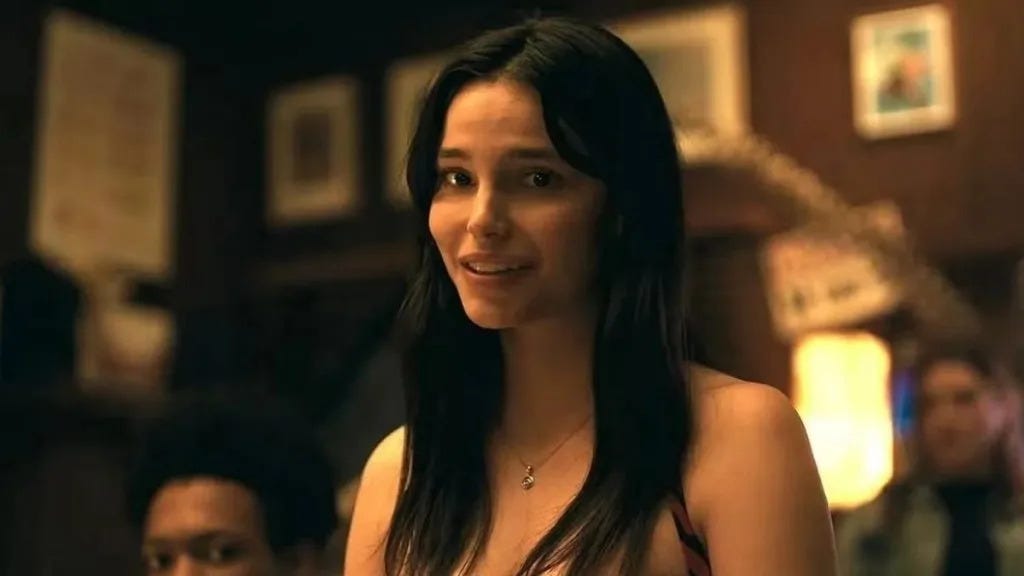
At a party in front of friends, Nikki smashes her head against the table, which we later read as Nikki briefly regaining control and attempting to end her suffering. Bear dissociates while their friends are yelling at him to help her. When they return home together from the hospital, Bear breaks the silence between them by asking Nikki “Why did you do this? Why did you act like this?”. For Bear the embarrassment and failure of Nikki to live up to his fantasy of the perfect girlfriend are more important than her rapidly deteriorating physical and mental health.
The Bear of the beginning of the movie, is the same Bear at the end, concerned only with his own feelings over everyone else. The wish didn’t turn him into someone new. It just removed the one obstacle preventing him getting what he always wanted: a version of Nikki that would never say no.
What causes so many men to skip past the film’s plainly stated message, I think, is how recognizable Bear is. The awkward friend nursing a crush he’s too nervous to voice, convinced that kindness is a heroic act. They see in Bear a version of themselves and race to defend the shared narrative both tell themselves, that being a nice guy has earned them something. In doing so they miss entirely the entitlement it is drenched in, and how it avoids ever considering the thoughts or feelings of the other person.
It is this entitlement, and hunger for forced devotion, that keeps men trapped in isolation, mistaking captivity for romance and disagreement for betrayal. Women get valued not for their personality, talents or companionship, but for how well they perform the role of the subservient maid who exists only to please her man. And when the actual, inconvenient reality of a person fails to live up to that fantasy, they grow disappointed, angry and resentful.
Which is exactly what makes a Bear with a day job and an apartment far more dangerous to be around than one with claws and fur.